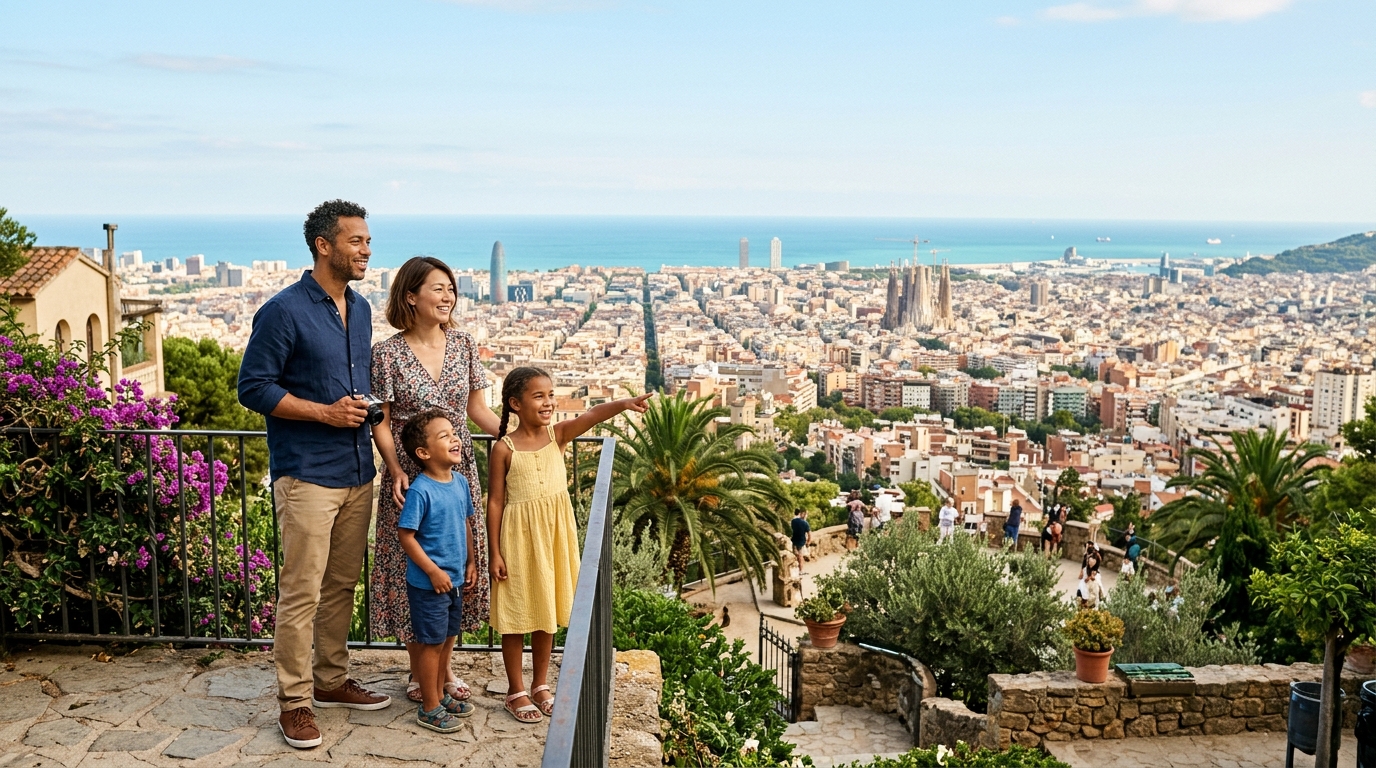
Living in Barcelona with kids can be very different from spending a week there as a tourist. A successful family move depends less on sightseeing and more on everyday logistics: where children will study, how long the school run takes, what kind of neighbourhood suits your routine and how easily everyone can settle into a new language and culture.
Is Barcelona a good place to live with children?
Barcelona appeals to international families because it combines the services of a major European city with a lifestyle that often takes place outdoors. Beaches, parks, neighbourhood squares and nearby coastal towns expand the options for family time, while public transport makes it possible to manage many daily activities without depending entirely on a car.
The experience, however, changes considerably when a temporary visit becomes a long-term stay. Housing, education and commuting become more important than proximity to tourist attractions. A central apartment may look ideal on a map but become inconvenient if school, work and after-school activities are all located in different parts of the metropolitan area.
Start with the school, then choose where to live
Families sometimes begin a relocation by searching for the most attractive neighbourhood and only investigate schools afterwards. In Barcelona, reversing that order can make everyday life considerably easier. International, private and local education options are spread across the city and surrounding towns, so the campus location can have a direct impact on where it makes sense to rent or buy a home.
Curriculum is another factor that deserves attention early in the process. A child who may move to another country again in a few years has different requirements from one whose family plans to settle permanently in Catalonia. Continuity, language, class environment and future qualifications should be considered together. One practical rule is useful when building the shortlist: Choose an international school in Barcelona for your children. Once the educational options are clear, compare the actual journey between each campus and the areas where you would realistically live.

What should parents compare?
A school should not be judged from a single feature such as language of instruction or distance from the city centre. The strongest choice is usually the one that works academically and practically for the individual child and the family as a whole.
- Curriculum: consider whether continuity with a British, international, Spanish or Catalan pathway matters.
- Age range: check whether siblings can remain on the same campus or educational pathway.
- Languages: distinguish between the main teaching language and additional language learning.
- Commute: calculate the journey during school hours rather than relying only on distance.
- Admissions: ask about availability, application dates and documentation before committing to housing.
- School life: compare sports, outdoor activities, clubs, pastoral care and other elements that affect the child’s routine.
It also helps to think several years ahead. A convenient decision for the first term may become less suitable as children move into secondary education, so families expecting a long stay should look at the full educational pathway rather than focusing exclusively on the current year group.
Choosing between Barcelona and the surrounding coast
Living in Barcelona itself offers obvious advantages for families who value urban life. Daily access to shops, cultural activities, public transport and established neighbourhood services can simplify the week. Areas with a more residential feel may provide a useful balance between city convenience and a calmer family environment.
But the city boundary does not need to define the search. The Maresme coast, extending north from Barcelona along the Mediterranean, can appeal to families who prefer more space, access to the sea and a quieter residential rhythm. Towns outside the centre may also place families closer to a chosen school, making them more practical than a prestigious address in Barcelona with a difficult twice-daily commute.
Think in travel time, not kilometres
A home and school can appear close geographically while still producing an inconvenient daily journey. Test the route at the times you would actually travel, including the return journey and connections with workplaces, sports facilities or childcare.
For younger children in particular, reducing unnecessary travel can change the rhythm of the entire household. Shorter journeys leave more time for sleep, play and family activities, making the location of the home part of the educational decision rather than a separate housing question.
Plan the first months around everyday routines
The first weeks after an international move involve more than unpacking boxes. Families may need to organise registrations, healthcare, banking, transport and school paperwork while learning how their new neighbourhood works. A predictable routine helps children adapt while adults deal with the administrative side of relocation.
Instead of trying to reproduce the family’s previous schedule immediately, allow some flexibility. Meal times, shop opening patterns, school schedules and social habits may feel different. Adaptation is usually easier when families observe the local rhythm before filling every afternoon with activities.
Build a small local radius first
During the first month, knowing a few reliable places can be more useful than knowing the whole city. Identify the nearest supermarket, pharmacy, playground, medical centre and practical transport connections. This creates a familiar base while the rest of Barcelona gradually becomes easier to navigate.
Children can benefit from the same approach. A favourite park, bakery or weekend walking route can quickly become part of their mental map of home. Familiarity turns an unfamiliar destination into a neighbourhood, which matters when the move has involved changes in school, language and friendships at the same time.
Language and cultural adaptation for children
Barcelona and Catalonia have both Catalan and Spanish as important languages in public and everyday life. International families may also use English or another language at home and school. Children can therefore encounter a genuinely multilingual environment, although their level of exposure will depend heavily on the school and community they join.
Parents do not need to expect immediate fluency. What matters first is allowing children to participate confidently in ordinary situations. Greetings, playground vocabulary, food names and simple everyday expressions create useful early wins. Regular contact with local children through sport, music or neighbourhood activities can then make language learning more meaningful.
Avoid turning every interaction into a lesson
Children often learn differently from adults because much of their language acquisition happens through play and repetition. Social confidence can be as important as formal study during the first stage of adaptation.
For this reason, leaving room for unstructured interaction is worthwhile. A football game, birthday party or afternoon in the park provides a reason to communicate. Language becomes part of daily life rather than another relocation task, which can make the transition feel more natural.
Discover Barcelona beyond the tourist checklist
Once the family routine is established, Barcelona becomes easier to enjoy at a slower pace. Instead of trying to see several major attractions in a single weekend, residents can experience the city neighbourhood by neighbourhood, returning to parks, markets and cultural spaces as children become familiar with them.
Parents also need time for their own interests. Barcelona’s food culture, nearby vineyards and social scene offer plenty of possibilities once childcare and routines are organised. For example, our guide to planning a wine tasting in Barcelona shows how an experience can be arranged in advance, something that may be useful when relatives or friends visit after the move.
Use weekends to understand the region
Barcelona works well as a base for discovering Catalonia rather than as an isolated city destination. Short trips can introduce children to beaches, mountains, historic towns and different landscapes without requiring a major holiday plan every time.
The same travel mindset can eventually extend beyond Spain. Families who enjoy Mediterranean city breaks may want to compare Barcelona with destinations elsewhere in southern Europe; our overview of places to visit in Naples is one example. Living abroad often changes travel from an occasional event into part of family life.
A practical order for planning the move
Relocations become difficult when several major decisions depend on one another. Housing depends on school location, transport depends on housing, and the arrival date may depend on both admissions and work. Putting the decisions in the right sequence reduces expensive changes later.
- Define the expected length of the stay and whether another international move is likely.
- Compare education systems before narrowing the search to individual schools.
- Contact shortlisted schools to confirm admissions requirements and availability.
- Map realistic school and work journeys before choosing a neighbourhood.
- Shortlist housing only after the family’s main daily routes are clear.
- Prepare essential documentation before arrival whenever possible.
- Keep the first weeks flexible while children and adults establish new routines.
This order does not remove every surprise, but it prevents one of the most common relocation problems: discovering that several individually good choices do not work well together. The objective is a sustainable weekly routine, not simply the best school, apartment or neighbourhood considered in isolation.
Common mistakes families can avoid
One frequent mistake is choosing a home during a short visit based mainly on atmosphere. A lively central street can be attractive during a weekend but less practical for school mornings. Judge neighbourhoods according to weekday life as well as leisure time.
Another mistake is underestimating the adjustment period for children who appear enthusiastic about the move. Excitement and uncertainty can exist at the same time. Keeping familiar routines while gradually introducing new experiences can provide useful stability, especially during the first school term.
Do not overload the first weeks
Parents naturally want children to make friends quickly, learn languages and enjoy their new city. Scheduling several clubs and activities immediately can have the opposite effect. Leave enough unscheduled time for rest and adjustment before committing to a full extracurricular calendar.
The same principle applies to sightseeing. Barcelona will still be there after the first month. A family that lives in the city can discover it gradually, which often produces a more rewarding experience than approaching every weekend like a short holiday.
Frequently asked questions about moving to Barcelona with kids
Every relocation is different, but several questions repeatedly appear when families begin planning. Most of them come back to the relationship between school, location and daily routine.
The answers also depend on how permanent the move will be. A two-year international assignment and a long-term move to Catalonia may require very different priorities, particularly regarding languages and education.
Should we choose the school or neighbourhood first?
For many international families, shortlisting schools first is more practical. Once the likely campus locations are known, it becomes easier to compare neighbourhoods according to commuting time, housing and family lifestyle.
Do we need to live in central Barcelona?
No. Families can consider both city neighbourhoods and towns in the wider metropolitan and coastal areas. The best location is the one that makes the family’s regular journeys manageable, rather than simply the address closest to major attractions.
Will children need Catalan or Spanish immediately?
The answer depends on the educational environment and daily routine. Children attending an international school may study mainly in another language while encountering Spanish and Catalan socially. Early exposure to useful everyday language can make integration easier even when fluency is not required from the first day.
How early should families start planning?
Begin before the housing search whenever possible, particularly when school admission will influence where the family lives. Education, commute and housing should be planned as connected decisions rather than three independent tasks.
Barcelona can offer families much more than an attractive place to spend a few months. With the right preparation, the city and its surrounding coast can become a practical base for school, work and Mediterranean family life. Start with the decisions that shape every weekday, leave space for adaptation, and let the travel experiences develop naturally once daily life is working well.

